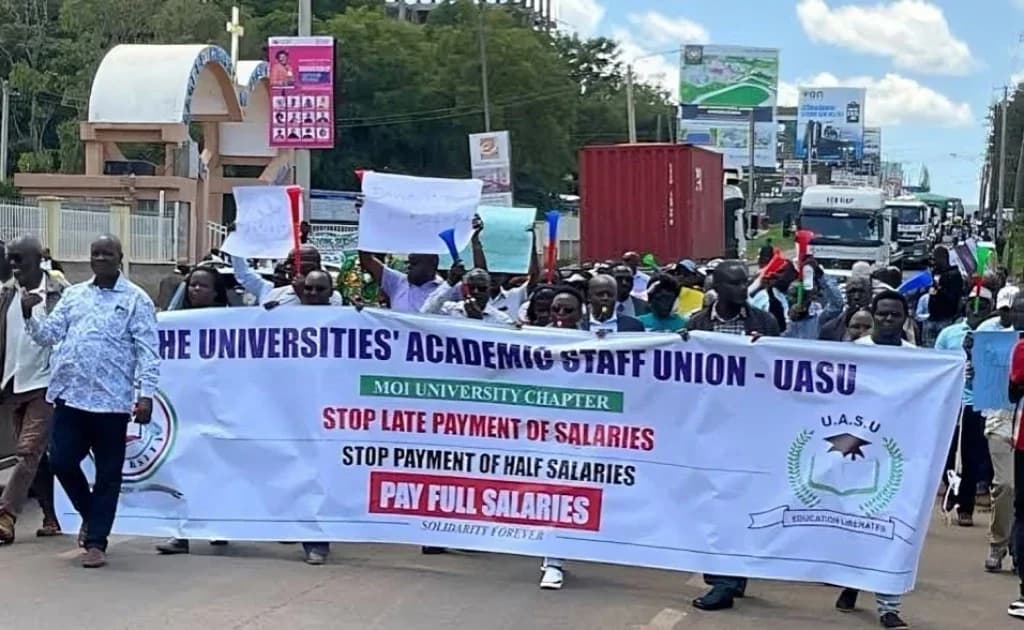
University Lecturers Begin Nationwide Strike Over 2025-2029 CBA
Teaching and learning have been disrupted in public universities after lecturers and other staff downed their tools over unresolved pay, allowances and working-condition concerns.
Nairobi, Kenya | October 2, 2026
University lecturers and other university staff have begun a nationwide strike after negotiations over the 2025-2029 Collective Bargaining Agreement (CBA) between unions and the government broke down.
The strike, which began on Friday, involves members of the Universities Academic Staff Union (UASU), Kenya Universities Staff Union (KUSU) and Kenya Union of Domestic, Hotels, Educational Institutions, Hospitals and Allied Workers (KUDHEIHA).
The unions have cited disagreements over salaries, allowances, staffing levels, working conditions and other employment-related issues as reasons for the industrial action.
UASU Secretary-General Constantine Wasonga said negotiations with the Inter-Public Universities Councils Consultative Forum (IPUCCF) had been ongoing since November 2025 but had failed to produce an agreement acceptable to the unions.
A proposed figure of about KSh9.76 billion for implementing the new CBA has been rejected by the unions, who argue that the amount would not adequately address their demands.
The unions also rejected a proposed four per cent annual salary increment put forward during the negotiations, saying it did not sufficiently address the issues affecting university staff.
Among the unions' demands are improved salaries and allowances, harmonisation of allowances, promotions, better medical coverage and improved working conditions. They have also raised concerns over staff shortages and the workload facing employees in public universities.
The unions have further pointed to the failure to fully implement commitments contained in a Return-to-Work Formula signed on November 5, 2025, which has remained a point of contention in the negotiations.
The IPUCCF made a counter-offer during the negotiations, but the unions rejected the proposal, leading to the collapse of talks and the decision to proceed with the strike.
The industrial action has already affected teaching and learning activities in several public universities, with students facing disruptions to lectures and other academic programmes. Universities including Egerton University, the Technical University of Kenya and other institutions have reported disruptions following the commencement of the strike.
The strike could also affect examinations, academic calendars and other scheduled university activities if the dispute continues.
The unions have, however, indicated that they remain open to negotiations and a possible resolution of the dispute.
The government and public universities are under continued pressure to address the financial challenges facing the sector while meeting staff employment obligations. Universities have previously raised concerns over inadequate funding, rising operational costs and shortages of academic and support staff.
As the strike continues, attention is now turning to renewed negotiations between the unions and the IPUCCF, with students and university staff awaiting an agreement that could restore normal academic activities across public institutions.