Kwale Residents Return Title Deeds Issued by Ruto Over Alleged Irregularities
Beneficiaries in Lunga Lunga say some documents contain outstanding payment conditions and inaccurate land allocations, prompting calls for government intervention and a review of the titling process.
Nairobi, Kenya | November 3, 2026
A section of residents in Kwale County have surrendered title deeds issued under President William Ruto’s government, citing alleged irregularities in the documents and concerns over the allocation of their land.
The affected beneficiaries say some of the certificates contain conditions requiring them to pay additional fees before the titles can be completed, despite assurances during the issuance exercise that the government had already covered the processing costs.
The complaints have raised concerns over the accuracy and reliability of the documents, with residents demanding that the relevant government agencies investigate the discrepancies and issue corrected titles.
John Kassim, a resident of Lunga Lunga, said some beneficiaries were surprised to discover outstanding payment conditions on their title deeds after being assured that they would not be required to make additional payments.
He said the wording had created uncertainty over the documents, prompting affected residents to surrender them for review.
Other beneficiaries also reported difficulties when attempting to use the title deeds as security for loans from commercial banks. They claimed that some financial institutions questioned the documents, frustrating their expectations of using the titles to access credit.
Another affected resident, said the situation had undermined beneficiaries’ confidence in the documents, which they had expected to provide secure ownership and greater financial opportunities.
Beyond the documentation concerns, residents have also questioned the size of the land parcels allocated to some families.
Some beneficiaries claim they received smaller plots than the land their families had occupied, cultivated or expected to inherit over generations.
The complaints follow earlier objections by another group of Kwale residents who rejected title deeds after discovering that some allocations measured approximately 50 by 100 feet, significantly smaller than the ancestral land they said their families had occupied.
Residents have also raised concerns over alleged irregular subdivisions, claiming that some properties previously occupied by individual households were divided among several beneficiaries, while other long-term occupants were left out of the allocation process.
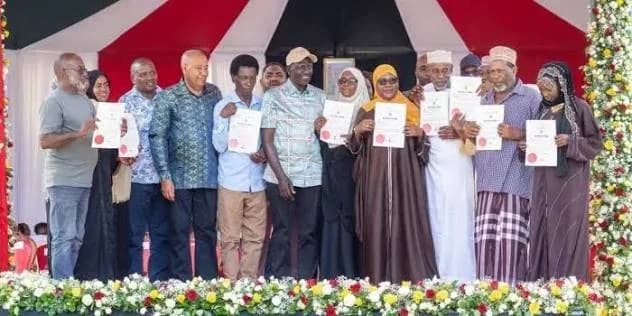
The latest complaints follow President Ruto’s September 28 visit to Kibaoni in Lunga Lunga, where he presided over the issuance of 26,000 title deeds as part of the government’s efforts to address longstanding land ownership challenges at the Coast.
The wider Kwale titling programme covers 94,175 beneficiaries across Lunga Lunga, Msambweni and Kinango constituencies.
During the issuance ceremony, Ruto assured beneficiaries that the government had covered the costs involved in processing the titles and warned against anyone demanding money from residents.
The President also announced a target of issuing 500,000 title deeds across the Coast region by the end of 2026.
The government has presented the programme as part of its broader efforts to resolve historical land injustices, address squatter challenges and provide formal ownership documents to communities that have lived on the land for decades.
However, the latest complaints have raised questions about the implementation of the initiative, particularly the verification of beneficiaries, land measurements, subdivision records and the accuracy of the final documentation.
The affected residents are now calling on President Ruto and the Ministry of Lands to intervene, review the disputed documents and establish whether the alleged discrepancies resulted from administrative errors or unresolved ownership disputes.
They want the government to investigate the claims, correct inaccurate records and issue revised title deeds reflecting what they consider their rightful land allocations.
The allegations had not received a detailed public response from the relevant government authorities at the time of publication.
For families who have waited years for formal recognition of their land rights, the priority is now to obtain accurate documents they can rely on to establish ownership, protect their property and access services that require proof of land ownership.